Image Map
Showing posts with label Rigor. Show all posts

June 20, 2019

How to Use Project Based Learning to Put on a Parade!

Have you ever wondered how you could easily add a Project Based Learning activity to your classroom?  Are you wondering how to put the project on display?   Sometime it can be merged as one!  Simply put on a Project Based Learning Parade!  


Float Parade Blog Post header


Where to Start?

First, pick a theme!  Every parade has a theme, so a Project Based Parade should have a theme!  Dive into your curriculum to see what could be developed into a project with the outcome as a float-because that's the point of a parade, great floats!  Here are two ideas:  

State Park Floats:  This project explored both the state in general and the region of the US it is found in.  It is primarily to learn about the 50 States.


State Park Float


National Park Floats:  This project explored both the National Park's history and the ecosystems found there.  It incorporated the food chain found in the National Park.  


National Park Project float


You see, both of these have a rich research base.  So, another piece of advice when diving into your curriculum is to look for something with a rich research base.  State flags, maps, park outlines, dates, ecosystems, tourist spots, etc. are all parts of the research base for this kind of project.   What topic are you studying that can allow for this rich base to be met?


Technology Integration

Next, you need to think about how much technology integration do you want?  Students can create research outcomes to accompany the float through the use of technology.  PowerPoints and other documentation can be help students to organize and present the information that they need beyond the actual parade float.  Consider this in your decision making process.

State Project


National Park Project


A post shared by Julie from The Best Days (@thebestdaysclassroom) on


Research Time

Questions about Research Time include how much of a guideline do you want to provide, how much time do students need, and do you want them to complete research in class or at home?  This will also determine your lesson plans and the development of your research questions.  This last point is key to where students go.  Scaffolding them in their research will help them to feel successful throughout the process, whether completed at home or at school! 


National Park Pages Preview of student work


Presentions

Next, you will want to think about how the presentations in class will be planned and what you will need for them.  Developing a rubric is SO important to this part-and the whole!  Research says that when teachers provide  a rubric, students can succeed at a greater rate.  Plus, it eliminates any negotiation for students who do not complete the task.  So, develop that rubric and get it into students hands!  


National Park Project Teacher pages


Once you are ready to present, have volunteers go first.  Students who are comfortable presenting will boost other's confidence and provide a foundation for others.  I try to pick students I know will offer great presentations so that others see and know what the expectations are.  This will often spur them into practicing more too!


The Parade

Finally, coordinate the parade beforehand!  This means you should send our emails to your staff to let them know the day and time you will be parading!  Students in other classes give the project builders the ooo's and ahh's that just make them feel successful!  Visit as many grade levels and classes as possible!  This means lots of eyes on their projects and a desire to make projects in the future!  That's a key to great project success!  


Once you have engaged in a Project Based Parade you will fall in love and want to do it every year!  Here are two projects to get you going - they provide everything you need for a great project parade!  


State Float Park Parade


National Park Float Parade Project


As always, I'd love to hear from you and what you like to do for Project Based Learning!  Drop a comment below or follow me over at Instagram or Facebook for classroom updates!  

Pin for Later:  

Float Parade Pin


January 30, 2018

5 Steps to Creating a Great Anchor Chart WITH Students


This may be an unpopular view, but I'm anti pre-made anchor charts.  With all the Pinterest charts and materials flying around out there, teachers have begun to loose that one thing that matters-the STUDENTS!  We have the shabby chic classroom that means nothing to students.  We have the Pinterestly perfect accessories and the ultra deluxe bookshelves that make everything Southern Living perfect.  Including our anchor charts.  Anchor charts-a tool to teach children.  A tool for children to use.  A tool that is interactive.  A tool 100% designed to be done with children, in front of children, and have meaning to that child because THEY had the learning presented to them in a way that makes sense.  Anchor chart-NOT a poster made at home by a teacher to make sure their class is Pinterestingly Perfect!  

However, even I recognize the need for a great looking anchor chart every now and again. In the age of the Pinterestingly Perfect anchor chart, there has to be a happy medium.  I also get the main goal of time saving.  However, what I don't agree with is the idea that students are presented the information in poster format and having that called an anchor chart.  So, is there a way to combine them into one.  I think so!  

Step 1

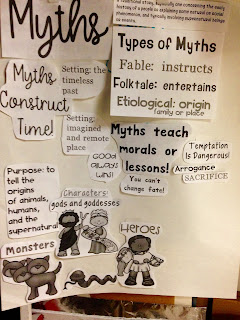
Determine what you want your anchor chart topic to be.  In this case, I was introducing myths to my students.  I wanted to present the facts behind myths to my students.  I started with a large header and went from there.  I had researched the elements of the myth and knew what I wanted the chart to hold. Then I went to designing.  I designed these.  

Step 2

Next, I created a mock-up.  I printed my design in black and white so that I could see how it would fit on the chart paper.  I laid it out with the end in mind-making sure it all fits!  

Step 3

Next I printed the pieces in color and cut them out.  I also clipped them together in the order that I wanted to introduce them to the students.  This way, I was ready and organized for the lesson sharing the elements of the myth.  


Step 4

Present the lesson.  At this point, glue is your best friend.  I kept a picture of the mock-up on my phone so that I always knew what was coming next.  I glued and discussed with the students as we went.  They had lots of questions for each part as we worked, instead of seeing everything at once.  I would have totally lost them the whole lesson with those monsters if I had presented this chart all at once!  They were fascinated with them both!  


These materials will soon be available in my TpT store!

What we ended up with was a great looking Anchor chart that was teacher driven but completed in front of the students.  The students interacted with the material and learned it in a sequence that did not overwhelm them all at once.  Our discussions about each part allowed for the building of the knowledge they needed but, yet, did not give it to them all at once!  

Anyone can develop charts like this.  All you need are some great fonts, some great clipart, and a little bit of time to think it through and type it up-just like any anchor chart you would make without students present.  The difference is, students are present and part of the development when done this way, which deepens their learning!  

I hope this helps you think about how you develop anchor charts with students.  I'd love to hear what you have to say!  Let me know in the comments below!  

This come from my King Midas and The Golden Touch product!  


Pin for Later


July 29, 2015

Perspectives on the Best Standards Ever Written!


 As I wrote about yesterday, I was lucky enough to attend a Key Note presentation by Dr. Jim Cunningham that was held in my district.  If you missed my first post, it is found here.  During this presentation, Dr. Cunningham shared why the Common Core Writing Standards are the BEST writing standards ever written!  He enlightened the audience to some hidden gems right in the standards themselves.  Then, he went on to talk about some very different perspectives than those that most teachers have about writing and the Writing Process-that’s what we will focus on-perspectives!  Here we go!

DON'T Grade All their Writing

Students are reluctant to write because of a lot of reasons, many of which come back to the fact that they are worried about how and what will be grades, even in the very early grades.  My first graders would always ask things like, “How long should it be?” “Is it for a grade?”  The first question I wouldn’t address except with, “What do you think is acceptable to me,” but the second one I would always answer with “Yes!”   How else would I determine how they were doing!  Boy, was I wrong!  We should let kids write and SHARE-lots of sharing should go on!  By sharing, students begin to write.  By writing more, they become less reluctant!  By answering NO to grades, they become less reluctant!  By grading less, we actually practice the Standards, especially in grades K and 1.  Language Standard 1 actually speaks to this very thing!  See, perspective!  By practicing the standards, we can actually open up kids’ hearts to this whole process and eliminate reluctance!  Amazing! (Hang on, because he talked about assessing!)

Write more and in more ways!  

          He talked a lot about Quick Writes, including ideas such as writing DURING learning.  One of the best ways to address rigor in a lesson is to conduct a Quick Write that gets them writing in a different way!  A great question to respond to that adds rigor is “What was the hardest part for you?”  Again, perspective!  How to look at writing in different ways!

            Next, Dr. Cunningham pointed out that the Writing Process is NOT a skill!  We make it a skill, us big people!  We blow it!  Why?  He quickly pointed out that the Writing Process is for TEACHERS not students!  We use it to focus on skills to teach, to guide our instruction.  Yet, we want kids to do it.  It’s like we get it totally backwards and his perspective opens thoughts and ideas about a whole new world of understanding!  And publishing!  According to the latest research, it is over rated!  Students learn NOTHING from publishing!  WHAT!  He has a good point!  Think about how kids REALLY feel about publishing!  Just go there for a second!  Perspective!  What should we focus on?  Dr. Cunningham quickly points towards 1.  Planning, 2.  Revising, and 3.  Editing! 


 Let's Start With Planning!

      “If we are to teach them opinion, informational, and narrative writing, then we better teach prompts.”  Thank you Dr. Cunningham!  Can I say I almost stood up and cheered!  “We aren’t doing kids favors with free writing.”  WHOOT!  I know this breaks the mold of most primary teachers, but I’ve believed this for years!  I’ve tried free writing and it was a mess.  Most kids didn’t have a clue of what to do!  Dr. Cunningham points directly to the fact that if kids are going to grow into writers for the real world, then they better be able to write to a prompt.  Think about almost everything you write right now-prompt writing, isn’t it!  Even this piece!  What is my goal-to communicate information!  What is my prompt-changed perspectives about writing!  Changed perspectives are key!  The nice thing is, Dr. Cunningham points to mentor texts as being a key element in teaching kids to write!  Think about all the fun you can have with prompts based on ideas from mentor texts!  So, kids need to have a prompt, create a plan (used to keep their writing focused) and write, write, and write some more!


Here's Another Perspective to Think About!

Have students write, share, and store FIRST DRAFTS!  Huh??!!  That was my perspective.  What about that whole great Writing Process deal he was going to be speaking about?  Perspective right!  Well, he explained that since kids are already reluctantly writing, they’re even more reluctant when it gets to revising!  My experience speaks to this totally!  They will edit, but when asked to do more-no way!  And he says research points to this!   There is no benefit to kids revising because they DON’T WANT TOO!  That is so TRUE!  However, there are ways to fix this!  Get ready for some real perspective!!  Don’t do any revising UNTIL you have written at least 3 of a type of writing!  For instance, on your third narrative you can begin to revise.  Kids by then will have learned to write without the fear of something else “coming”.  He also points to providing guidelines for revisions-and guess where they come from?  The Standards also provide the guidelines for revision! I LOVE this guy’s perspective!  Use the Standards to find your guidelines and then have kids go through ONE guideline to improve.  Slowly work through them, with EVERYONE revising-either by adding to the piece or creating a more in depth piece (such as the opening).  Genius!!!  Follow the same plan for editing because, guess what, they are in the STANDARDS! 

One more thing that he really opened a new perspective to was grading-and it was eye opening.  He stressed using Formative Assessments a lot.  It is a relatively simple idea-pick ONE skill and check how students are progressing and changing.  Use that information to guide your instruction with either small groups or whole groups!  This can be used in looking at the type of writing they are doing, focus skills such as organization, steps in revising (one), and editing skills (one).  And, here’s one more real perspective changer-when we do assess kids formally, it should be a FIRST DRAFT document!  Dr. Cunningham stressed that this draft was what the student could really do, really write!  That is where we should be looking, investigating our student successes and strengths!  This is where we should find new perspectives! 

Wow, that’s a lot of new perspectives to share on the best standards ever written!  I am excited to try a lot of these in my class this year, to brighten my students’ views on writing, and to add rigor!  Thank you Dr. Cunningham for sharing such great insights into our current writing trends and The Best Standards EVER! 

Want to read more about my thoughts on writing!  Check out my other posts, including:

Modeling, Planning Style

Giving Up the Writing Program: Here's What I'm Doing      
Instead


Pin for Later!


Best Standards Every Written


July 28, 2015

The Best Standards Ever Written-Part 1


           Today I was lucky enough to attend a Key Note Session for my district’s conference.  I was aware that it was about writing and that James Cunningham was the speaker, but that was all that I was aware of.  Dr. James Cunningham is a professor at the University of North Carolina and this man knew his stuff!  The focus was what current research says and what works with the Common Core State Standards-and, in his words, “The Best Standards Ever Written” for writing instruction.  I’d have to say, after hearing him, he is right!  So, let’s dive right in!

            He quickly pointed to the “Bad News”.  The “Bad News” was to point out the reasons why writing doesn’t work in most classrooms.  Rigor demands that we focus on it, but we don’t-research says so, scores point to it being so!  Why is this?  First, and foremost, it mainly points to being the most unimportant in people’s eyes, not just teachers.  Research (I’m going to say this A LOT!) points to the fact that we, the adults, don’t take it serious.  Why?  It is “undervalued by those who remember when it wasn’t important.”  That’s us folks!  Right there, in our classrooms.  Our memories of writing keep us from making it important!  Parent’s memories of writing keep them from seeing it as important!  Yet, the demands in our jobs, and in our students’ future jobs, all point to it being a key element in success!  One of the surprising things Mr. Cunningham shared was that when the Great Recession hit, secretaries decreased while laptop use increase!  More low paying jobs were eliminated, those that didn’t involve writing, while jobs involving writing increased.  Plus, more and more college classes are involving both formal writing and writing online responses.  Writing truly is KEY to our future!  Yet, our assigned writing times in our classrooms lag behind both reading and math!  Not good!  But, there is some good news!

            The “GOOD news “ is something that may be VERY surprising to many of us.  I know it was to me!  Writing is EASIER to teach than either math or reading!  Not only that, but it doesn’t depend on a student’s home background like it does in reading!  That means that it is an equal opportunity in my book!  I can totally see this as fact in my experiences in teaching.  This year one of my struggling students was one of my BEST writers!  It was amazing to me, but this research backs it up!  Plus, as we have always known, it improves reading.  BUT, it also improves content area learning!  Think about all the applications in the content area that writing is applied too!  We just don’t always see that the writing is a KEY element! 

            What makes these the BEST Standards Ever Written?  Dr. Cunningham pointed to three key standards-Writing Standard 4, 10, and 5-and in that order!  Check this out!  Standard 4 is the WHOLE GOAL of writing in life!  Stop looking for goals, because it is RIGHT THERE!  Wow!  That was kinda eye opening!  It has been glaring at us all along, right there!  This man has it going on!  Next, Standard 10 points to a key to get kids writing-ROUTINE!  Writing has to become ROUTINE!  And it is, again, RIGHT THERE!  How about 5??  It is the Writing Process!  But wait-not like we use it, not like we want the kids to use it-but to STRENGTHEN writing in a different way! 

            This is it for right now!  Digest that, because some of his ideas and thoughts and research are kinda MIND BLOWING, yet they are things that we know, have developed an understanding for, but are used differently!  So, stay tuned-more to come tomorrow about these great new ideas coming from the most current research!