Image Map

July 13, 2013

Summer Reading with a Lesson on Conceptual Development


What are you doing this summer?  I’m doing A LOT of reading!  I mean, A LOT!  I have read a number of children’s novels, the three Hunger Games books (Boy, was my husband glad when I was done!), and a number of professional books and guides.  One of the books that I have read is by an author I know personally, Jodi O’Meara.  Jodi wrote RTI with Differentiated Instruction, Grades K-5.  It wasn’t the personal connection I had with Jodi that lead me to read this book, it was my drive to learn what the RTI process was really about, I mean, REALLY!  Boy, was I surprised. 


You see, we have been lead to believe that remediation is RTI.  Here’s the kids test score, fix them.  That’s the impression I had with what RTI was.  Do some stuff, make a cute chart, wham-done!  Now, before anyone starts “screaming” at me, please understand my lag in understanding. During the induction of RTI in my district, I was not in a standard classroom. I have had many wonderful teaching experiences, and at this point, I was in the Science Lab, where I saw every student in my school on a rotation of a 6-day wheel.  During RTI training, I paid little attention, literally, to the process and what it entailed.  That was a rarity for me.  I’m usually into this kind of stuff-but I was tuned out, literally.  It didn’t have application for me in that moment.  So, I’m behind.  In walks Jodi’s book, literally, in her hands!  (I'm saying literally a lot today!) 

What did I glean from this book-A LOT (Another problem word today!)?  How the real process works, how to differentiate to help the process through and have the time to possibly really make a difference because of that differentiation. How to make various charts that show real growth compared to expected and/or small group instruction, and about……drum roll please……..How to approach conceptual skills! 

I know, another thing we think we all know!  How to handle conceptual skills?  Now, here is where my first freebee, the FCAT Specs, comes into play.  When you really look at what the medium to high complexity questions lie, they lie in understanding at a conceptual level.  How, on earth, do we get them there and master them there, and know that they have??? And, folks, this is Common Core in a nutshell-How do we get them there!

Jodie offers a few really good points! Start with our thinking-how I can understand what is expected. And, most importantly, what are the criteria for mastery then!  Have we REALLY answered that for each conceptual benchmark presented to us?  Do we REALLY know what and how kids master those?  Should we be relying on what a company tells us??  All good questions to ponder-and work on!  Do I have all the answers right now?  No!  Will I be working at it?  Yes!  In fact, with my teaching partner Lisa, we have agreed on what is skill and conceptual, or a combo of each, for the present standards.  Knowing enough about the Common Core Standards, many of these will just transfer to that!   A real goal to work toward.

With that being said, here are two more items that will, at least, answer that for these benchmarks.

1.                     Weekly Nonfiction Reading Sheet: In this two-pack document you will find all you need to keep kids practicing text structure identification and text feature skills.  It can be used with any informational book.

2.                     Shades of Meaning Continuum:  Use any word group to have kids practice the shades of meanings of words.  I plan to pull my words from the Book Club books they are reading.  They fill in the continuum, write a sentence for each, use one more word in a sentence, and explain which word(s) they are going to keep on                  using!  Good way to assess something so conceptual!


     May I highly recommend Jodi’s book. As you can tell from the numerous post-it note flags sticking out, there are many ideas I will be coming back to the book to use for the school year.  I will be making a number of charts to collect data from as well.  It is well written and easy to read.  There are scenarios to help build conceptual understanding (many of the names I recognized!), as she practices what she teaches in the text!  Thanks for a good read Jodi!

Julie:O)


July 12, 2013

The Native American Mall Project


One of the most fun and learning worthy projects my teaching partner, Lisa, and I did this year with our kids was the Native American Mall Project.  For Social Studies, we must cover the Native Americans of Florida.  So I went about finding a way to cover the information in a research/project based fashion. 

One of my favorite jumpstart places is a book called 51 Wacky We-Search Reports by Barry Lane.  There are just some fun, silly ideas that get the mind working.  And that’s exactly what happened with mine!  I suddenly was struck with the idea that all of the things we wanted the kids to learn about-food, dress, house ware, hardware, and what they looked like, could all be found in STORES!  Yes, some strange thought lead to this, and that lead to the Native American Mall Project. 

First, I showed them how to do the research. Within the packet is a sample research page.  The kids research their Native American tribe for a week at school.  During that week, they worked on the research based on how the team itself, that consisted of 5 kids, decided!  Yes, I let them decide.  Some groups assigned each child a topic, others did all the research separate and then came together to discuss what they agreed on, and some worked all together.  It was very interesting to see what each group decided.  It was also more interesting to see the kids that sat back and didn’t do the work, only to find out the rest of the group wasn’t just going to give it to them!  Yes, this is 4th grade, where they can make those kinds of decisions and teach others a lesson while still being fair and nice about it!  All of the research was completed in mini notebook that was collected with their final projects and scored on the rubric! 


Once this was completed, the teams also decided who would be doing what store for their wing of the mall.  I was waiting for complaints and concerns about not being able to do a particular task, but there where none!  The kids had, on their own, decided who was doing what even before this final meeting.  So, off went the notes and the booklet home to complete the second phase of work-the at home project! It is important to note that this phase can also be done in the classroom!  It is not necessary to send the projects home to be completed!  They had one week to complete the project end of the activity.

Now, this can be approached two ways.  My directions to the kids included that they had to be flat projects that could be attached to the wall of the hall.  Lisa, my teaching partner, directed the kids that it could be either a poster or a creative replication.  When you use this project, be sure you know what you want the kids to do.  She was ready to display their projects on flat tables. I was in a location in my hall that would have lead to some disasters occurring if I had done that.  I have lots of little hands going by my room.  Both types of projects were amazing, so either will work!

Once the projects came to school, then the students presented them orally.  We had worked a lot this year on how to present your information, both visually and orally, so I was really pleased with what they shared.  Some were very simple, and to the point. Others were elaborate and may have missed the point!  One thing I gleaned from this experience was that I REALLY have to stress that it needs to address the whole tribe.  What was important to that tribe and how do you prove it in your work.  That’s what seemed to happen to the few kids who missed the mark. They focused on one thing, or person, to represent the whole tribe and couldn’t tell about the whole tribes needs, ideas, etc. 

I did take lots of pictures and will eventually create and offer a power point that discusses these very things, including strong and weak presentations, how to improve simple presentations, and what a great presentation looks like!

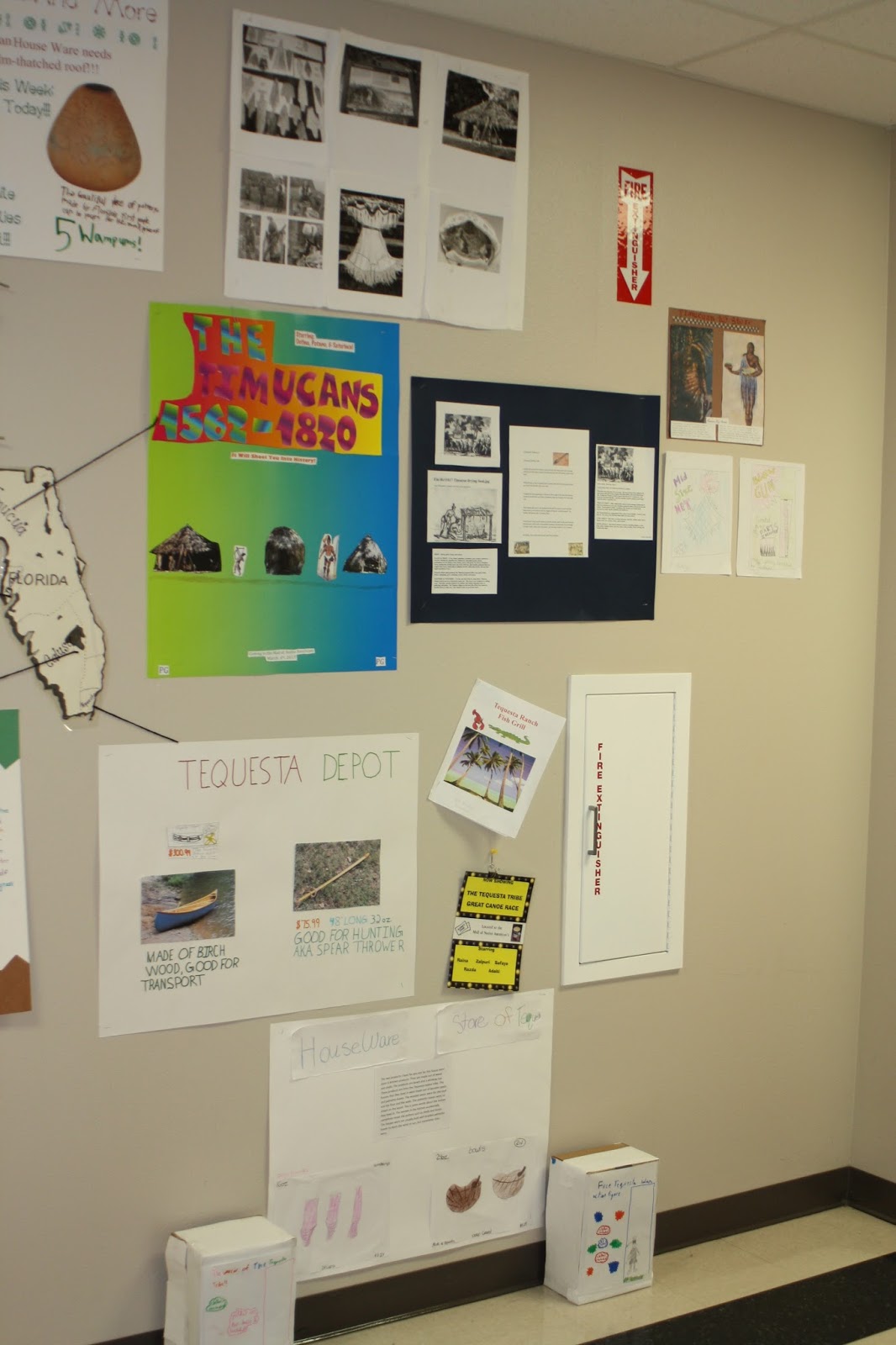
In the meantime, here are some of the finished products!

This one is very fun and included a complete sales pitch by the student!  
This movie poster included information about the "Fierce People"!

This is a great example of how you can be very creative and still be "flat" to hang on the wall!
The way my room is, I can't take a direct picture.  Notice I had one student who did boxes.  He also was able to show me how I can hang them on the wall!  It just worked out that his tribe was at the bottom of Florida!

The other side of the project wall!

For the Native American Mall Packet, click here!  


Thanks for stopping by and I hope this project will inspire you to try Project Based Learning if you have never done it before!


July 11, 2013

Starting Out!

      The road behind my blog is fitting, for now.  I am just starting out into the crazy world of Blogging and selling on TPT!  In fact, I haven't even opened my store yet, deciding instead to start here.  So, what will it hold?  Only the BEST DAYS ahead will guide us to that!  Let's get started and see where we go.

      Our first road will be a freebee!  Yes, free stuff is good stuff.  This items that I am soon to upload into my newly created "store" will be my FCAT Test Specs Breakdown for 4th grade.  I had learned years ago that if you REALLY want to know what your students are being tested on, you should go through these with a fine toothed comb!  So I did!  It was enlightening and challenging all at once.  The only way I could truly process this information was to create a chart.  The chart follows the guidelines of how the test questions are formed-low, moderate, and high complexity.  It is very important to know that these complexities are how they ASK the question, how the complexity interacts with the question, NOT on how the child interacts with it.  I found this to be very enlightening.  I have to stop thinking about how the students interacts with the question, but how the question interacts with those around it.  This has lead me to a few different ways of thinking and creating, yet not always be "teaching" to the test.  Many of my posts will be just about that-how to still engage the students in learning but not wrap them up into the crazy world of high-stakes testing!

     So, now I have my overall goal-how to engage the students in learning but not wrap them up into the crazy world of high-stakes testing!  I love a challenge, and this is it, for now.  There is so much more to come onto the horizon for me.  We haven't even really started Common Core in my district (but some of us dabble without the invitation!)  So many BEST DAYS ahead!

Here's the link to my FIRST PRODUCT!