Image Map

January 29, 2019

Book Club for Kids: The Secret of Getting the BEST out of Student Jobs


Book Clubs for kids are a primary tool of reading instruction in my classroom!  They are used in place of Guided Reading instruction and are much more informative than the actual practice of Guided Reading.  One of the secrets to Book Clubs for kids is picking roles, or jobs, that provide the most value to the students and the teacher!  


The boy is doing Book club for kids with a Book Club Job or Role to complete.


Your Purpose Might Just Be Hiding!  


Before we dive into jobs, let's talk a minute about purpose!  Everything we do as teachers should have a purpose.  I have honestly read other teachers share that their Book Clubs for kids have no purpose besides being a Book Club.  This, my friends, has a deeper purpose!  You are using the skill of talking about REAL LITERATURE in a real world setting!  That means you should be diving into researching this topic to build a structure for this talk, a structure to teach real literature without the kids knowing it!  Higher order thinking is your real goal-learn how to utilize it in this setting!  Because everything we do HAS A PURPOSE!  Look for it, it is there!  


The Best Book Club for Kids Jobs!


There are so many ways you can utilize Literature Circle Roles.  These roles were shared by Harvey Daniels in Voice and Choice in Literature Circles.  It was simple then to utilize these roles to teach within Book Clubs for kids.  I used these roles, or jobs as we now call them, with my first real experiences back when I first learned about Literature Circles.  However, times have changed.  The demand of testing and the new Standards that most of us teach under, has really called to us about how to build skills and understanding within the texts students read.  That means we need to have jobs that have the most bang for our buck!  Above all, students need to be practicing skills that can be bridged back to the Standards and meet the demand of testing.  These five jobs do just that!  


Job #1:  Summarizer


This job is just what it is named.  Students write a summary of their reading.  This could be a chapter or even multiple chapters.  This process is key to many smaller parts of a variety of standards.  Determining key details, sequencing, and critically examining the text are ways that students use reading to build a summary!  Plus, students strengthen their vocabulary and writing skills, as they cannot just copy sentences from the text.  This is not a skill to take lightly.  Writing summaries together, giving feedback on summaries written, and reteaching to your class will all be part of this job.  In the end, it is worth the time to do this.  Your students will boost so many reading skills just through learning how to properly write a summary!  Take the time to use this valuable job in Books Clubs for kids!  


Job #2 Questioner


This job is so much more than asking questions.  But, let's start with the obvious!  When you are looking at the basics of the new standards, you will find that many of the foundations start in asking questions about a text.  And, yet, kids struggle with doing this!  They struggle with finding questions with real meat to them.  This can be developed through Book Clubs for kids.  The job of Questioner is about asking quality questions and, also, providing an answer.  As a teacher, this gives me insight into what students are questioning as they read.  When you look at this deeper, you an clearly develop an understanding of their higher-order thinking.  If students are stuck on obvious questions, they are lacking higher-order thinking.  It is my job to begin to cultivate this through lessons.  If students still struggle, it is time for some one-on-one help to build this area up.  Their answer are just as insightful.  A student can ask a great question, but totally miss the mark that their answer can have multiple answers.  It is when students open up to the idea that a question can have many answers that debate occurs-and it does, naturally, in Book Clubs for kids.  

In addition to developing question to ask the group, the Questioner is responsible for running the group.  This starts very early on when I still sit with the groups, especially in the younger grades.  I try to act as a silent witness, offering as little guidance as possible.  This helps in the gradual release to student-led Book Clubs.  I have my students use the Questioner form to work through their Book Club leading.  Soon, students are leading, no matter what their ability is!  


Job #3:  Plot Picker


This job in Book Clubs for kids is another way for students to meet specific Standards that you need to assess.  They need to critically analyze the text to determine the climax of the chapter or section they are reading.  Students must wade through key details to pick the moment that impacts the story the most.  This can be difficult for students since there may be a variety of opinions based on what they are reading. This job, more than any of the others, can lead to a real debate among students-and that is what you are looking for.  Students can strengthen their skills of talking correctly and building debate naturally within the Book Club structure.  Be sure to be watching for it and guiding it along.  I have used good group debates as "fishbowl" moments.  I have the students recreate their debate and have others watch.  This way, we can talk about successful debates and how you correctly talk and react within them.  This words for any grade (I have even done this with First Graders!) 


Job #4:  Character Sketcher


Character Sketcher is 100% looking at Character Traits.  Students must choose a moment from their reading and explain this character through traits that they see in their reading.  This is a key moment to assess the difference between actions and reactions.  This one is difficult for students when it really comes down to it.  They think the characters actions cause the trait, when in reality it is their reactions that are the trait.  Continued practice in Book Clubs for kids is a simple way to build and grow this skill to mastery.  Kids are looking at their character across a WHOLE story, across many events and many interactions with others.  This is what is missing in those guided reading books. (Read more here!) There is not enough depth to characters in these texts to get what students need!  That is why real literature in Book Clubs just does amazing things with students.  And this is a job that proves that fact!  


Job #5:  Connector


Emotions play a huge role in who we are as readers.  This is why this job is important.  It takes the time to dive into the feelings of the reader and to dig into their schema.  I will never forget when one of my toughest fifth graders ever was reading Old Yeller'.  We were in the middle of Book Club and I was monitoring their group.  I was standing behind him when he started.  All of a sudden he broke down in tears.  He explained that when he was younger one of his dogs died and how this story brought him right to that moment and how he just knew how Travis had to have felt.  He just knew it  because it was exactly how he felt.  It was powerful and moving.  We were a tight knit group, so it didn't go anywhere past our classroom-and all the kids hugged hime sometime in the day.  It was real, it was powerful, it was real literature in action!  It was also 15 years ago for me-and it has stayed with me all that time.  That is the power of connecting in Book Clubs for kids!  


Other Jobs


Yes, there are other jobs.  Here is what I have to say about that!  I have tried all of the other jobs and have personally found that they lack the depth of the jobs I have shared here.  These can (and are included in my Book Club products) Word Nerd, Visualizer, Passage Picker, and Travel Tracer.  The problem with these is not found in the job itself.  All have their value.  The problem lies in the sharing of the job.  With Word Nerd, students loose interest hearing words and their definitions.  This can cause off-task behaviors to jump up and disrupt your groups.  I find that if I let kids pick words across the text and do this job as an individual product, I get better results.  Visualizer is a weak job in general.  Students must show a picture and discuss their picture.  I find this amount of drawing, especially with older kids, is not a good use of classroom time.  Again, this one can be used at the end to share "the moment" that stuck with them!  The two that have some traction are Passage Picker and Travel Tracer.  Both look more closely at the reading, but both can be somewhat boring to listeners and frustrating to the student completing the task.  What if they reading only has one setting (Travel Tracer) or too many settings?!  What if the student doesn't like this part of the reading and finds no value in the passages they have read?  All of these are areas I've had students struggle with.  These struggles are an important part of understanding the Book Club jobs presented here!  


Differentiation!  

The good news is that ALL of these Book Club roles can be differentiated to meet the needs of your students.  You will find value in all the jobs presented when you are differentiating.  Each and every one of these jobs becomes important to students if you look at what they need in that moment.  A struggling reader just may need that Visualizing job when they are completing a Book Club.  It's easy to differentiate by having leveled pages representing each job.  


This shows Differentiated Book Club Job sheets for a variety of needs.


Differentiated book club pages are shown in the basic level of learning


Students can easily be assigned what they need, even when reading the same text.  Each of the sets come with their own leveling.  The Basic Set leveling includes a story level and a chapter level that support a larger area of drawing.  Then they move into limited drawing on the page and no drawing, focusing on the written element alone.  This allows for an easy transition into completely written work.  

The Advanced Set includes the first page offered as the limited drawing. Some students in grades 3-5 will benefit from drawing, but I find it is key to keep the written work as the most important element on the pages.  The goal with Book Clubs for Kids in the intermediate grades should always be about what they are presenting to the group in written form, not the drawings that accompany the work.  I think this can get lost sometimes in Book Clubs!  But, just like with the Basic Level of Book Clubs, this set can easily be differentiated to meet the needs of each of the students in your classroom!  

What do you think about these jobs, or roles for Book Clubs for kids?  I'd love to know what works for you, what doesn't work for you, or what you are interested in hearing more of?!  Leave me a comment or hit me up on Facebook or Instagram!  (Be sure to follow to get all the most recent information about my classroom!) 

Pin for Later


This blog post is about how to get the best jobs or roles for your students in Book Clubs for Kids

Read other Book Club for Kids Posts


January 22, 2019

Book Clubs for Kids: Why Student Choice is NOT that Hard to Do!

Book Clubs for kids, also known as Literature Circles, have been around for a very long time.  However,  Book Clubs for kids is one of the most underutilized tools in the teacher's tool chest of skills.  When you look at Balanced Reading's fundamental truths, it screams Book Clubs for kids, especially for older elementary students.  Yet, we continue to follow the guidelines of Big Business in our classrooms and go with the readers provided by these book companies than to provide real literature with a purpose.  Book Clubs for kids do just that!  So, how do we pick books and how do we allow students a choice in book picks without them being unrealistic their reading levels.  Here's how!  


This girl is happy because she is getting to pick the Book Club books!  Her choice!


First of all, it is key to understand that student accountability and responsibility is the fundamental element of Book Clubs for kids!  Without it, you will be chasing students down and all around your classroom trying to get them to complete this work.  Starting with the basics of how to do Book Clubs for kids must come from you, but the rest is based on their ability to be a member of a group that is counting on them.  This is why Book Club book choice is so key to the success of the Clubs themselves.  I will state, for the record, that I DO CHOOSE THE BOOKS IN THE END for each student-just in case you want to give up because this seems too far fetched for you!  It's all in how you manipulate the choice that gets the group to be cohesive and complete!  Let's take a look!  

Purpose

First, target your groups needs.  This can be as simple as reading level to as complex as character development through deep analysis.  You must decide what the purpose of the group is.  You will also be looking at what children you want to put in this group!  Have a flexible list, because this is where the fine manipulation comes into play-having that general list.  Here's an example of where I am going with my class:

  • Advance Reading Level and Comprehension - 2 groups
  • Character Development - 2 groups
  • Continue Basic Comprehension and Growth - 1 group

Book Selection

Next, I select the books I want to use.  This step, at times, can come first.  I usually work together within these steps, as I know what books I have sets of.  I target the books and what kids I want to have in each groups.  Again, I keep a flexible list, because I know I can change groups around based on their interest too!  This year I'm in Second Grade, so here's what I'm looking at for book choice next:
  • Tornado by Betsy Byard - 2 groups
  • Frog and Toad - 2 groups for Character Development
  • Henry and Mudge - 1 group, Basic Comprehension 

Student Book Choice

Now comes the next step, student choice.  Label the books you are planning to use.  I put post-its on the books numbered 1-4.  I allow students to examine the books, including reading the back, looking inside,  and checking out anything else they may want to do.  I do this in smaller groups, over the course of one or two days.  Students want to see and examine the books to make good choices.  This should become an important step to the selection process.  Plus, it gives you time to prep folders and papers as they are doing this.  


Next, I print out post-its for book selection.  Each student gets a book selection post-it.  They write their name and their book choices-1st, 2nd, and 3rd-on the post-it.  They turn it into me so that I have their choices.  It's as easy as this!  Again, it's a fine game of manipulation after this, but you have done one of the most important steps to student buy-in!  

Assigning Books

It is time for the grand manipulation.  Here's how this goes down!  First, sort all the groups by who picked what for their first choices.  You can then pull those kids that you have picked earlier for those books.  This one is easy.  Next, examine where your second book picks fall.  Usually, I can place all of my kids by the first or second choice.  They really do pick the right books.  When I get a student who has not picked the book I need for them to be in, I look at the following:
  1. Is there room in the Book Club they want this time!  If it isn't too far of a stretch, I will usually look at this as a choice.  
  2. Did the child at least pick their "book" as third choice.  
  3. If the child did not pick their "book", I pull them and I conference with them.  I explain that their book choice was filled and that ________ is the only spot I have.  (The next part is KEY!!!)  Then I promise them FIRST CHOICE next time-and I make sure I write it down and STICK TO IT! 
They are usually thrilled with this idea, because they know their valued in the process.  All the while, you are winning at getting them in their proper Book Club books!  

I do believe that this is all a very gentle balance.  It is always key to remember that student choice is one of the key components in Book Clubs with kids!  If you over use play this balance, they get onto your game and you will have some difficulty completing that fine art of manipulation.  Value their choices and balance it with your needs-it works every time!  Any other tricks and idea, drop me a comment!  

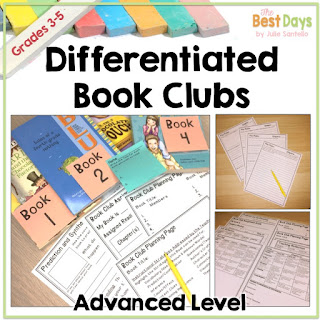
Differentiated Book Clubs:  These products contain all you need to accomplish amazing Book Club moments in your classroom!  


Advanced level of book clubs are for 3rd, 4th, and 5th grade students.


Pin for Later!  

This child is picking a book for Book Clubs for Kids!  Students choice is key


Read more about Book Clubs for Kids here too!  


January 15, 2019

Why I Don't Do Guided Reading! Book Clubs Exposed!!!


Book Club for kids is another name for Literature Circles.


I have lucky to be in on many innovative educational ideas.  I have seen the rise and fall of educational concepts.  It has been an interesting time.  One of the best ideas I have seen, and practiced, is the use of Literature Circles, or Book Clubs for kids.  It is also one of the most under utilized strategies with teachers.  Let's take a look at why!  


Book Clubs for Kids


Literature Circles, or Book Clubs for kids,  have probably been around longer than we can imagine.  I can retrace my experience back to my first year of teaching.  I taught Fifth Grade and had this great idea from college to try out.  My peer teacher was extremely innovative and agreed to let me try them out.  She was a steady novel user herself-in fact, she still is a novel user! (More on that in other posts!) I had used novels right along with her, mainly to get the most band for the buck!  My Brother Sam is Dead is a great example of this most bang moment!  This amazing novel teaches the American Revolution from an amazing view point - that of a Revolutionist who also put his life on the line for his family, all told by his young brother who was not fighting in the War.  Great stuff - but I digress!  So, I gather the texts I wanted to use - The Secret Garden, Alice in Wonderland, The Jungle Book, and Huckleberry Finn.  These books were not a huge jump for my students - in fact, because of what we were reading, they fit right into our class.  I created a project too - they had to write a summary for each chapter and draw a picture to create a Big Book for a younger grade!  All was great - but I had NO IDEA what I was doing!  This was totally unstructured talk with a random project.  I would rotate and listen to them.  They would all write a summary!  Great, but with no real results.  No real ability to "see" what I needed to see from them.  And, so, like so many others, I gave up this very "innovative" idea and stuck to what I was learning from others - the use of really great literature with the whole class.   Until...

Balanced Literacy!


Yes, about ten years into my teaching career, Balanced Literacy was launched.  It was during this time that "Guided Reading" was introduced to us and it was quickly pushed aside by those that I taught with.  In fact, it was a somewhat verbal assault on the instructor of the course.  But, she would not be pushes aside so easy.  Over the course of our year's worth of classes, she began to make headway - with BOOK CLUBS for kids!  She quickly moved from the idea that small readers were for all students into reading novels with older kids.   This brought buy-in!  In fact, she brought us to the point that students in 2nd grade and beyond SHOULD be reading real literature in the form of NOVELS!  And that's where she found acceptance and understanding!  And that's why I don't do Guided Reading in my classroom - in ANY grade I've taught!  Instead, I do...


Book Clubs!!


Literature Circles, or Book Clubs for kids, soon became a big hit with my students!  Why??  Well, there are a number of reasons!  Here's some:

  1. They offer student choice!  We all know that it is hard for teachers to give up the idea that students can choose their own books.  However, that is part of what Book Clubs for kids offer.  Choice gives a student more buy-in.  That means more time on task, a connection to social-emotional learning, a willingness to have cooperative behaviors, and just a better chance to have fun with their reading.  
  2. They provide a chance for differentiation!  That's right!  You can offer a variety of reading levels and topics in one Book Club for kids.  Or, you can go with a theme and offer a variety of levels of reading opportunity!  The opportunities are endless!  
  3. It provides a purpose for reading beyond the idea of taking a test!  YES!  It is real, it is engaging, it is opportunity!  Real literature is used.  Kids want to read when the book engages them-so pick quality with PURPOSE!  Understand what and why you have picked that text to use with them!  And, opportunity is present.  Opportunity to get students involved and loving a book for what it is and what it does for them as a reader! 

What Book Clubs for Kids are NOT! 


I shutter when I hear Guided Reading- for real, I do.  Because it has become what it should not be.  It is, in it's current form, Round-Robin Reading Groups.  Student groupings don't change, they are stuck in a cycle of boredom (and so is the teacher), and we are assessing everyone for fluency OVER AND OVER! (Why?? WHY?? If they are fluent-move ON!)  We don't boost their reading past what we "think" they should be doing!  Reading is NOT A LEVEL!  Therefore, Book Clubs are NOT Guided Reading!  

Book Clubs for kids are NOT a free-for-all either!  There is structure and planning in Book Clubs.  Students have roles and expectations- all of which they must be ready for.  It takes practice and work, but students can quickly learn the hows and whys when presented with opportunities to lead!  

Book Clubs for kids are NOT ungraded!  There are many ways to grade Book Clubs.  Be open to ideas for grading, even from the students.  They know what should and should not be going on in their groups and will be honest about their behaviors and reading.

Book Clubs for kids are NOT unguided.  I carefully scaffold my Book Club instruction.  I start the same for every grade, no matter what grade I have taught Book Clubs in, 1st through 5th.  When they learn the ropes, they learn quality Book Clubs!   

So, now that you are intrigued, I'd love for you to join me in learning more!  I'll be posting some Blog Posts and sharing some over on my Facebook Page!  Stop by and follow me there for my live discussions about Book Clubs!  And, let me know more about what you'd like to learn by leaving me a comment below!  


Book Club Products


Pin for Later!  

Book Clubs Exposed pin for Pinterest.  This post is about literature circles.


Read the next article on Book Clubs for kids HERE! 


January 8, 2019

Get Your Class Out of the Regrouping Rut with BINGO!

Do you love to play BINGO with kids!?  I know that my students LOVE Bingo!  But what they do tend to do with regrouping in addition and regrouping in subtraction is get bored!  So,  why not connect BINGO with kids and regrouping in addition and subtraction!  Let's take a look at why these two skills can be connected to gain academic success!  

This is a square picture that has BINGO for Kids and getting your class engaged in addition with regrouping and subtraction with regrouping.


Bingo Benefits!  


1.  BINGO with kids turns an activity from boring to exciting!  We have all seen it-with almost all games we end up playing with out class.  But there is something special about BINGO!  I don't know if it is the thrill of hunting the number that is called, the risk of winning, the risk of loosing, or all of it combined that makes this game GREAT!  

2.  It grows critical thinking skills - Yep, I didn't believe it till I did some investigation.  You see, when students are playing BINGO, they are forecasting the next set of possible events.  This kind of thinking builds the area of critical thinking skills.  It seems just too simple to be true-but it is! 

3.  It also works on a number of skills under the heading of "sportsmanship".  Students must learn to win,  loose, and celebrate others all while playing this game.  They are social and learn to talk to each other in a way that is acceptable to the category of sportsmanship.  

And, when you pair that with MATH you get a win-win situation!  

The Benefits to Your Math Instruction


Yes, there are benefits to your math instruction as well.  One of the best ways that you benefit is through engagement.  Students are motivated to win the game-and to win BINGO, you must be accurate.  When we play addition with regrouping or subtraction with regrouping BINGO,  I talk to my students about how inaccurate answers will cause them to instantly loose the game! If you don't have the right answer, you can't cross it off for the BINGO!  

Engagement is another area that boosts your math instruction in addition with regrouping or subtraction with regrouping.  When students have a purpose greater than "just practice", students will be more engaged.  These BINGOs have become one of the highest engaged moments in my classroom!  Imagine, students who want to practice this skill, are excited to practice, and have an end game in mind which leads to success!  LOVE IT!  

This is a cover of the Regrouping 2 Digit addition problems by playing Bingo for kids!

                         Play bingo for kids that include problems with 3 digit subtraction with regrouping.          Play bingo for kids that include problems with 3 digit subtraction with regrouping.

Play bingo for kids that include problems with 3 digit addition with regrouping.

How Simple is It?


It's this simple!  

1. Head on over to my TpT Store and check out the BINGO's I currently have available.

2.  Print out how many you need.  There are 25 game boards in each of these! 

3.  Print out the Calling Card - The great news is, you can call these numbers more than once! During our Math block, I am able to have students finish the work and we play BINGO about 3 times!  How awesome is that! 

I hope you have gained some ideas about the benefits of BINGO with kids, even beyond math!  It is a wonderful way to add engagement and fun in your classroom while you build critical thinking skills and sportsmanship!  I'd love to hear how you use BINGO in your classroom - so, drop a comment below!  

Pin for Later! 

This show two girls playing BINGO in the classroom using addition with regrouping and subtraction with regrouping.


July 24, 2018

Reflecting on Open Seating in the Classroom

Last summer I explored Student-Led Learning in depth and pledge to reflect upon that practice-and I failed at it!  Miserably!  However, I did not fail upon the practice of this, including my pledge to try Open SeatingOpen Seating is different than Flexible Seating as it allows students to find their own seat in the classroom.  In best practice, it is done on a daily basis.  (Check this article out!)  Upon reflecting on open seating in the classroom, here's what I found worked for me.


Students sitting around a table working together with text that says Reflecting on Open Seating in the Classroom


What "Kind of" Worked!

First, I did try the idea of weekly moving of students.  That is the best I could do with this practice.  We never moved into the ability to do a daily change.  It was a huge investment in weekly changes when I was working on that practice.  I slowly moved into bi-weekly, which ended up becoming monthly.  I just could NOT put that much time into moving students around, not in this testing environment.  In addition to this, my administration became REALLY strict about bell-to-bell instruction.  That included on Friday.  We had our RtI invention at the end of the day, including Fridays.  I just could NOT fit everything in.  So, it became a monthly changing of seats.  

Second, we tried truly Open Seating.  It worked for a good amount of students.  However, as you would predict, there were "those" kids who just could not do it.  It was fewer than I thought it would be, which was surprising.  Students had to be reminded to try new friends, even with the idea of trying subjects, etc.  They tended to still want to migrate to their friends.  Or, carry on a pattern.  


Surprising Finds


Patterns-we soon discovered that certain students had patterns, including areas of the classroom that they wanted to sit in.  It was very hard for these students to want to be flexible.  At first, when kids found "their" spots, I allowed for them to stay in that location for more than one rotation.  But then they never wanted to move!  It became a need because as the year progressed, some of the other students needed to be separated.  Same problems as a regular class!  The thing I kept coming back to is that I wanted them to feel comfortable in a spot that they felt allowed for them the best opportunity to learn.  That was the hardest thing to balance.  

A square picture with two girls working together with the text Open Seating Building Partnerships

Partnerships-This was the most interesting discovery!  Students really do have the ability to find learning partners.  It quickly became apparent that this Open Seating opportunity allowed for partnerships to strengthen and grow.  Frequently, students began to sit together.  I began to watch these partnerships closely, to see if there was value within them.  There was!  I then gave permission for those partners to begin to stay together!  This was amazing, but came with some consequences.  Just like anything, this could wear on these kids.  They actually then knew that it was time to move apart-and WOULD!  Soon, these teams were back at it, working together although their seats were not.  AWESOME!  

Overall, I'd try Open Seating in my classroom again.  Students can and do monitor their choices.  They do determine where the best learning location in a room is. They do know when to give up friends and move to working partnerships.  Again, this applies to the vast majority of students.  Just like in anything, reflecting on open seating in the classroom is just as good for students as it is for the teacher!  

Let me know your thinking on Open Seating in the Classroom!  I'd love to know if you have tried it or you are willing to try it!  If you are, I have just the product to get you started!  Find it in my store!  In the meantime, drop your thoughts in the comments!  


A square cover for the Open Seating Product on TpT offered in this blog post.  It shows the posters and tents available for this product.


Pin it Later

Pin for Open Seating that is vertical and shows two girls working together, a table team of students and the text saying Reflecting on Open Seating in the Classroom.


July 20, 2018

How to Request Supplies You Need at Back-to-School Night (Or Open House!)

Do you spend a lot of time agonizing over how to request supplies you need during your Back to School Night or Open House?  Many teachers use lists to show parents what they need for  the learning that goes on in their classroom.  Have you ever thought to use a themed Giving Tree for this all important request list?  Here are a few ideas for your classroom donations!

Mom is loving watching daughter build at Back-to-School Nite so she is going to get some supplies for her teacher using the Giving Tree found on the board!


Easy to Use Design

These Giving Trees are totally easy to use!  Inside each of the Giving Trees you will find the letters to complete your display, the 8.5' x 11" poster that communicates the fact that you need to get those supplies for your classroom, and awesome frames for you to write your supplies on.  Everything you need!


This is a picture of how to layout the Giving Tree on a white board for Open House or Back-to-School Nite.


Displaying Your Giving Tree

These are super easy to display too!  All you need is a white board, a bulletin board, your classroom door, or a display board!  I've seen them done in all of these ways!  Here's how you put this together.

1.  Print out all of the materials you will need.
2.  Cut out the letters and other items.  You may want to laminate them because you can sue them year after year!
3.  Write your wish list items one at a time on each frame.
4.  Display your Giving Tree in your room!
5. Get those supplies!  Whoot!!

This is a close-up of a sample poster and a frame filled out for Open House or Back-to-School Night.


Things to Remember!

Think across your school year and subjects for your supply needs.  Think about those craft projects or those STEM activities that escape you right now! Holiday parties and events are another thing to think about!  Dig into your year and go from there!  

It is always key to thank parents for the supplies that they send in.  Simply sending a thank you note is one of the easiest ways to thank them.  One great way to show everyone what supplies were donated and say thank you all at once is to make a picture collage of all the goodies and send it out to all the parents at once!  It's a super fun way to show your thanks!

Themes!

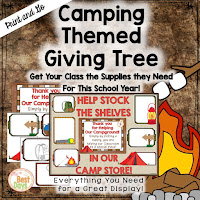
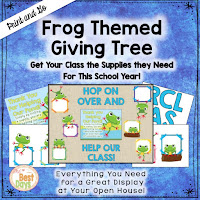
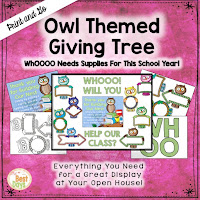
There are so many themes available that you should find something that meets your needs!  If you don't see one here, I could probably whip one up for your needs!  Simply leave a comment or email me at classroombestdays@gmail.com to share your idea!  Here are the themes available in my store now!

                             This Camping Themed Giving Tree is perfect to get your supplies for Back-to-School Nite or Open House!       This Frog Themed Giving Tree is perfect to get your supplies for Back-to-School Nite or Open House!

     This Owl Themed Giving Tree is perfect to get your supplies for Back-to-School Nite or Open House!       This Pineapple  Themed Giving Tree is perfect to get your supplies for Back-to-School Nite or Open House!

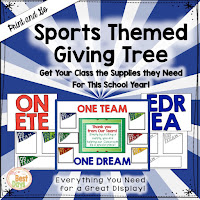
This Space Themed Giving Tree is perfect to get your supplies for Back-to-School Nite or Open House!       This Sports Themed Giving Tree is perfect to get your supplies for Back-to-School Nite or Open House!

This Star Bright Themed Giving Tree is perfect to get your supplies for Back-to-School Nite or Open House!       This Bird Themed Giving Tree is perfect to get your supplies for Back-to-School Nite or Open House!

This Superhero Themed Giving Tree is perfect to get your supplies for Back-to-School Nite or Open House!       This Racing Themed Giving Tree is perfect to get your supplies for Back-to-School Nite or Open House!


As you can see, using Giving Trees to request supplies you need at Back-to-School Night or Open House can be a simple and fun process.  I'd love to see you try one out!  Drop a comment if you have other ideas of how to ask for supplies!  We'd love your suggestions!

Want to discover more about how to make your classroom more student-led during the first week of school?  Check out this blog post!


Pin for Later

This pin shows the different giving trees available for Open House or Back-to-School!


July 18, 2018

How to Hack the Dreaded Teacher Observation Rubric to Save You Time

Teacher teaching class with girl smiling because she helped the teacher Hack the Dreaded Teacher Observation Rubric

Each year as teacher observations come around, everyone starts to panic!  One of the panics include:


"How in the WORLD am I going to get my student created rubric done for the lesson they are going to see!"

Yep!  Every. Single. Time!!  After my first year of getting "dinged" I realized that it can't just be for this observation, this moment. What are we really doing in our classrooms that things like this are only good enough for observation moments?  Do we not realize YET that kids aren't going to play into that kind of thing and that administrators (or, at least, let's hope) get that the kids have no idea what they are using that rubric for!  The fact is, every classroom should be creating rubrics with students and for students! But, we struggle with allowing them to create, to impact their learning and, in all of this, make our rubric rock for our observations!  I think I have found the PERFECT Teacher Observation Rubric Hack!  


How to Hack your Teacher Observation Rubric


First, determine what your end results for your observation needs to be.  This is what they students will be learning in the lesson that you are going to be teaching.  You want this to be fresh and new-nothing they have totally mastered.  If they have some ideas, that's ok.  My admin looked at my finished rubric and specifically asked if the students gave those outcomes.  I was able to say no!  That was a good thing.  My admin said that if they were able to give the outcomes in 4 levels, there was zero reason to do the lesson!  So, keep that little tidbit in mind as you are planning your observation!  

Next, create an anchor chart with the titles.  I simply headed it STEM and added a column for "Behaviors" and one for "Scientific Knowledge."  Your second column will be your curriculum focus.  You can even change your behaviors column to something like, "Grammar Elements" or "Center Work"-anything you need for your lesson!  Get creative!  


A  boy working on adding his post-it note to the Teacher Observation Rubric Hack chart in class.

Now comes the magic!  Gather your students to your carpet or meeting spot!  Explain that your administration will be coming into your classroom to record the story of your class.  I take this route because our administration talks to the students and writes things down.  This totally scared my kids the first time they did this because they have little to no contact with administration.  By explaining that they are writing a narrative piece, they are ok when they see their names being written down on the paper or computer they are using.  I tell them to be open to the story and to add whatever they can to make our classroom story be the best!  Next, I  introduced the chart.  My students knew that we would be observed and what we would be doing.  I shared this again with them and then asked them to think of other times we have worked through an activity like this!  We worked first on the behavior side.  I had them turn and talk about what behaviors they felt were key to this activity.  Then, here's the magic, I had them record information for behaviors with the idea that 4 was the best work and 1 was the lowest performing behaviors.  They could write to whatever they felt they know the most about!  All it take is one student's ideas to make this work, so don't stress that they are all perfect statements!  
Now, do this again with "general" knowledge of your topic.  Remember, you are not looking for them to nail it!  You want them to be general so you can adapt it, etc. to your needs!  You get to nail it!  
These are post-it note examples of how the students replied to the questions on the chart for the Teacher Observation Hack Rubric.


Whats Next?

Now, pull that chart off just as it is, take it home or someplace quiet, and get to work!  Here's what you do!  
1.  Set up a table in PowerPoint or some other document that will allow you to create the rubric.  You could also create it on another sheet of paper for display.
2.  Look for great quotes from students that you can adapt to the positive just enough to make your rubric work! 
3.  Look for levels of learning expectations (See the level 1 in that pic!)  
4. Create the teacher observation rubric from the students' statements and ADD THEIR NAME where their statement connects on the rubric!  Yep, nothing causes ownership like their names on a rubric!  
5.  You add the content specifics and add names only where needed.  Notice on mine, it is only at Level 1 because they actually targeted their struggles in this statement.  That came out during my observation!  


This is a rectangular page that shows the rubric information with students' names added to Hack my Teacher Observation Rubric.


Easy-peasy!  And, you have a beautifully designed teacher observation rubric with student-led learning wrapped inside!  This took me considerably less time than the rubric I made the year before.  That one took me DAYS of class time, because we had to do it in small doses!  This one was quick and easy!  Students loved their names on it and many were impressed that they even had the thoughts they did!  The only thing we did in addition to these steps was to share the actual content of the rubric the day before the observation.  Students also had a copy in their STEM folders and I was able to refer to it and remind them of their scoring criteria throughout the observation!  All in 1/2 the time of the previous rubric development in my classroom!  

How about you?  Have you developed an easy way to create a student-led observation rubric?  If so, I'd love to hear all about it!  Drop a comment and let us know!  


The product I used for my observation is available in my TpT Store!  
This is the Star STEM link to TpT I used during my observation and to hack my Teacher Observation Rubric

Want to read more about my ideas on the Teacher Observation System?  Check out this post!  

Pin for Later:  


Teacher teaching class with girl smiling because she helped the teacher Hack the Dreaded Teacher Observation Rubric